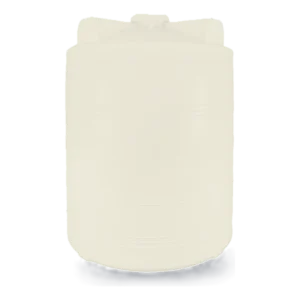
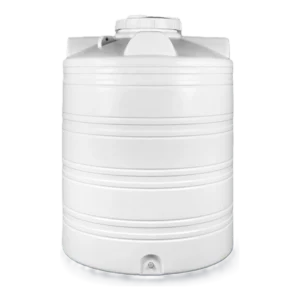
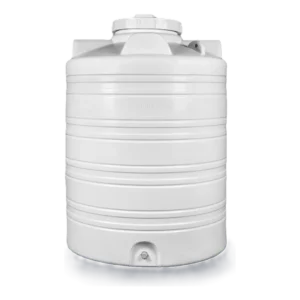
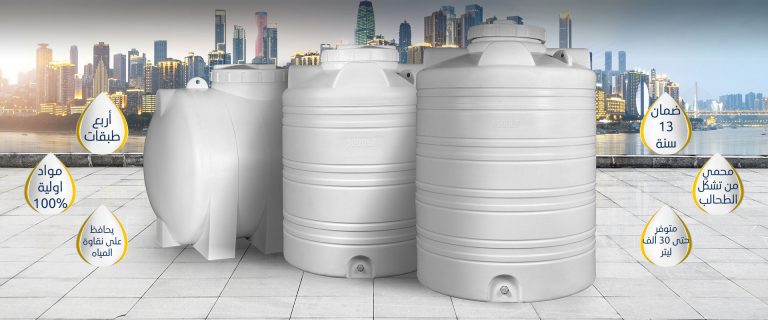
When buying a plastic water tank, most people focus on capacity and price. But there is another factor that matters just as much: how the tank is made. Some tanks are produced by blow molding, others by rotational molding – known in Iraq as “cast tanks” (خزانات الصب). The difference directly affects the strength, lifespan and water safety of the tank.
What is blow molding?
In blow molding, a heated tube of plastic is inflated with compressed air inside a mold until it takes the mold’s shape. It is fast and ideal for small containers such as bottles and jerrycans, but it faces challenges when making large tanks.
Main problems of blow-molded tanks
- Uneven wall thickness: the plastic stretches unevenly, so corners, edges and far points end up thinner – exactly where the tank carries the most stress.
- A pinch-off seam at the base: the plastic tube is closed at the bottom, leaving a seam line in the base – a potential weak point under the constant weight of water.
- Internal stresses: fast stretching and fast cooling leave stresses in the material that can later appear as cracks, especially with summer heat and sunlight.
- Difficult to make thick multi-layer walls: protection against sun and algae needs several well-built layers, which is harder in large blow-molded tanks.
What is rotational molding?
In rotational molding, polyethylene powder is placed in a closed mold that rotates slowly on two axes inside an oven. The plastic melts and coats the walls evenly, then cools gradually. It is the standard method worldwide for large water tanks, which is why in Iraq these tanks are commonly called cast tanks (خزانات الصب).
Advantages of rotationally molded tanks
- One seamless piece without welds or weak lines.
- Near-uniform wall thickness, with corners typically thicker and stronger.
- Lower internal stress thanks to gradual heating and cooling.
- Several layers possible (3, 4 or 5), each with a function: UV protection, light blocking against algae and thermal insulation.
- Suitable for large sizes from 300 to 30,000 litres.
How to recognise a good tank
- Ask about the manufacturing method and the grade of raw material.
- Check the corners and base: they should be thick and uniform with no visible lines.
- Make sure the tank has several layers and a white, food-grade inner layer.
- Ask for the datasheet and written warranty terms.
Conclusion
A cheap tank today can cost you more tomorrow. Choosing a rotationally molded, multi-layer tank made from virgin raw material means a longer life, cleaner water and peace of mind for years.
Frequently Asked Questions
Are all plastic tanks blow-molded?
No. High-quality large tanks are usually rotationally molded, while blow molding is typically used for smaller containers.
What do the multiple layers do?
The outer layer protects against UV rays, the middle layer blocks light to prevent algae, extra layers improve insulation, and the inner layer is food-grade for contact with drinking water.
Looking for a reliable water tank?
BAZ Plastic tanks are made from 100% virgin raw material, with multiple layers and a warranty of up to 20 years.